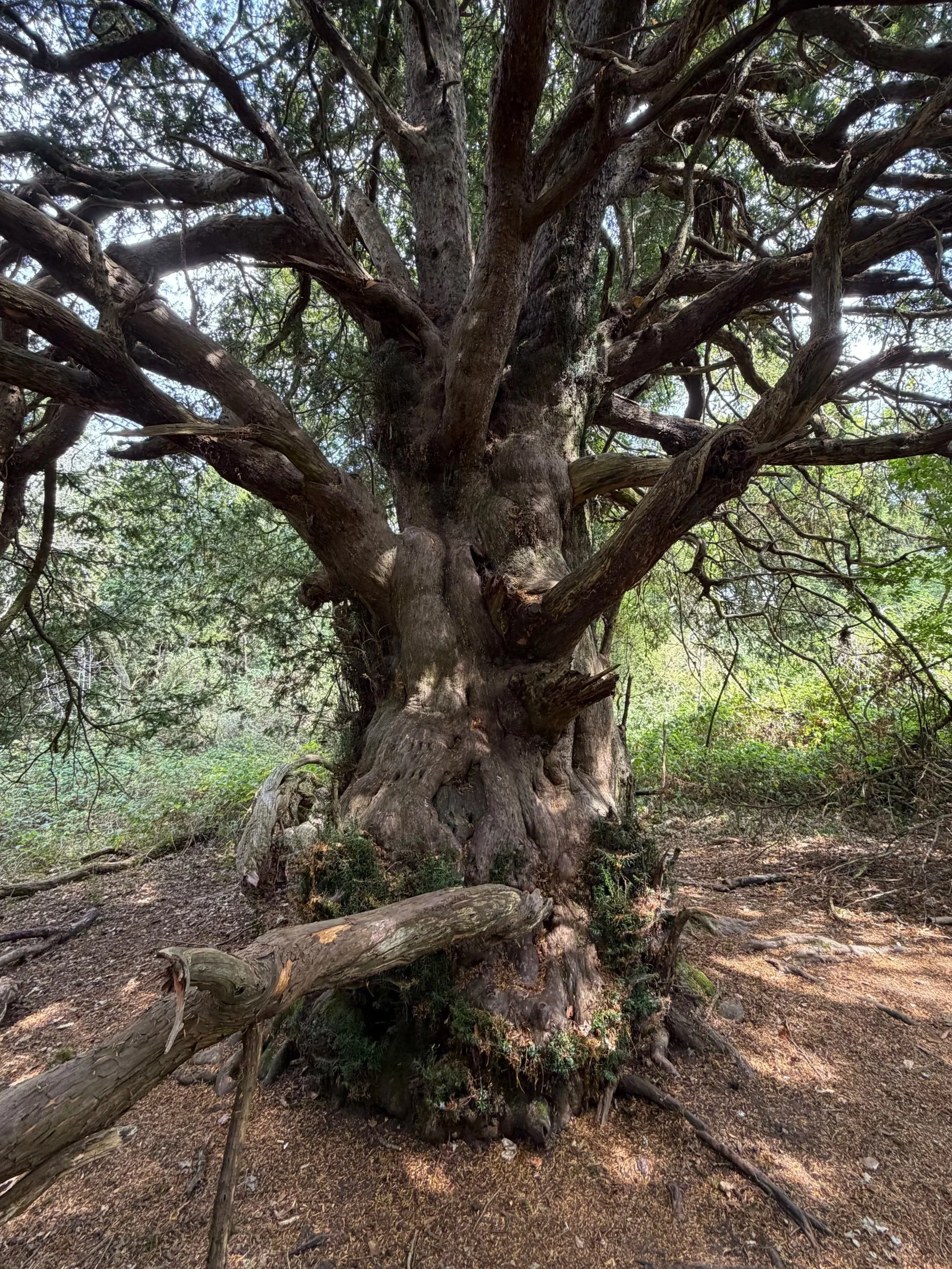
Taxus Baccata
The Common Yew Tree
The common yew (Taxus baccata) is a particularly interesting tree. Not only can yews live for thousands of years, but they are also often labelled “the tree of death”. Throughout history, yew trees have been associated with death, poison and the underworld. In Roman literature, they were connected with hell and believed to grow near the entrance to the underworld.
Interestingly, though, yews are evergreens. Life continues to run through them, yet death is a constant association. They outlive generations of humans. Most parts of a yew are poisonous if eaten, although the red fleshy covering around its seed (the aril) is not toxic. Yews nevertheless support the environment around them: their dense growth provides shelter for birds and insects, while their arils provide food for birds and small mammals.
The common yew has also contributed to cancer treatment. Compounds from yews led to the development of paclitaxel, an important chemotherapy drug used for breast and other cancers.
Initially, I was drawn to their breathtaking structures. As I have learnt more, I am beginning to understand that they are as interesting in their history and biology as they are in their form.
As a black-and-white enthusiast, I felt compelled to photograph these ancient trees.
Identifying a yew’s age is not simple. The usual method of counting growth rings does not always apply, particularly to ancient specimens. Over time, the heartwood at the centre of the trunk can decay, leaving the tree hollow. This means that cutting into an ancient yew may reveal no complete sequence of rings from which to determine its age.
Some ancient yews have been estimated to be as old as 5,000 years, but these figures are disputed. Recent research suggests that some trees once thought to be 3,000 to 6,000 years old could be considerably younger; experts continue to debate how old the oldest surviving yews really are.
As the core decays, the outer layers can remain functional. New branches reach out in all directions, seeking sunlight. In some yews, low or pendulous branches that touch the ground can take root, a process known as layering. Yews can also regenerate from old wood, stumps and roots. Over time, this constant rejuvenation can create a mass of twisted branches, compressed wood and new growth: a tree like no other.
As the photographs accumulated, I began seeing images within the images. For example the first image in the gallery looks akin to the surface of Jupiter. The more I looked, the more I saw. It became a kind of search. A hunt for the next abstraction to jump out at me. Then, after a while, I stopped seeing the tree entirely.
This project evolved into an investigation of abstraction.
Even now, I have images that remain unidentified, but, as with earlier photographs, the answers do not always reveal themselves straight away. So, if you do not see anything within the images, keep searching. Things can appear at any time. A friend’s interpretation can open up a completely new way of seeing a photograph. Once you see something, it is difficult to understand how you could not see it in the first place.